Molarity Calculator
This free molarity calculator finds the concentration of any solution instantly — enter the solute mass, molar mass and solution volume, and get moles plus molarity in mol/L. No signup needed.
How to Use the Molarity Calculator
- Find the moles of solute. Divide the solute mass in grams by its molar mass in g/mol: n = mass ÷ molar mass.
- Measure the solution volume in liters. If you have milliliters, divide by 1,000 first (500 mL = 0.5 L).
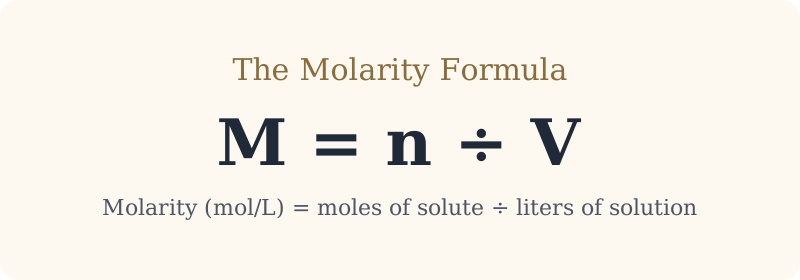
- Divide moles by volume. M = n ÷ V gives molarity in mol/L (M).
- Check your answer. A 1 M solution has 1 mole per liter — use that as a sanity check for your result.
New to solution chemistry? Read the molarity article on Wikipedia for the full background.
Worked Example: 1 M NaCl Solution
Sodium chloride (table salt) has a molar mass of 58.44 g/mol. To make 1 liter of 1 M solution:
| Step | Calculation | Result |
|---|---|---|
| Moles needed | M × V = 1 × 1 | 1 mol |
| Mass needed | n × molar mass = 1 × 58.44 | 58.44 g |
| Volume | bring to | 1.000 L |
| Molarity | n ÷ V = 1 ÷ 1 | 1.000 M |
So dissolve 58.44 g of NaCl in water and add water until the total solution volume is exactly 1 liter — that is a 1 M solution.
Quick Reference: Molar Masses of Common Substances
| Substance | Formula | Molar mass (g/mol) |
|---|---|---|
| Table salt | NaCl | 58.44 |
| Water | H₂O | 18.02 |
| Glucose | C₆H₁₂O₆ | 180.16 |
| Sucrose (sugar) | C₁₂H₂₂O₁₁ | 342.30 |
| Sodium hydroxide | NaOH | 40.00 |
| Hydrochloric acid | HCl | 36.46 |
| Sulfuric acid | H₂SO₄ | 98.08 |
| Calcium carbonate | CaCO₃ | 100.09 |
Frequently Asked Questions
What is molarity?
Molarity is the concentration of a solution: moles of solute per liter of solution (mol/L, written M). A 1 M NaCl solution has 1 mole of NaCl in every liter.
How do you calculate molarity?
Use M = n ÷ V: divide moles of solute by liters of solution. From mass: moles = mass (g) ÷ molar mass (g/mol), then divide by volume. The calculator above does both steps.
What is the difference between molarity and molality?
Molarity (M) is moles per liter of solution; molality (m) is moles per kilogram of solvent. Molarity shifts slightly with temperature (volume expands); molality does not.
How do I make a 1 M solution of NaCl?
Dissolve 58.44 g of NaCl (its molar mass) in water and bring the total solution volume to exactly 1 liter.
What units are used for molarity?
Moles per liter (mol/L), abbreviated M. So 0.5 M = 0.5 moles of solute per liter of solution.