Factor Calculator
Find every factor of any number instantly — plus the prime factorization, factor pairs, and whether the number is prime, composite, or perfect. Free, no signup.
All factors
Factor pairs
How to Find All Factors of a Number
- Start with 1 and the number itself. Every whole number is divisible by 1 and by itself, so these two factors are always there.
- Test each number up to the square root. If 5 divides 60, then 60 ÷ 5 = 12, so you get the factor pair (5, 12) for free.
- Skip the rest. Once you pass the square root, any new factor would be a repeat of a pair you already found.
- List them in order. Write the factors from smallest to largest — that is the complete set.
Worked Example: Factors of 60
The square root of 60 is about 7.7, so we only test 1 through 7:
| Test | Divides 60? | Factor pair |
|---|---|---|
| 1 | Yes | 1 × 60 |
| 2 | Yes | 2 × 30 |
| 3 | Yes | 3 × 20 |
| 4 | Yes | 4 × 15 |
| 5 | Yes | 5 × 12 |
| 6 | Yes | 6 × 10 |
| 7 | No | — |
So the factors of 60 are 1, 2, 3, 4, 5, 6, 10, 12, 15, 20, 30, 60 — twelve factors in total. Its prime factorization is 2² × 3 × 5.
Quick Reference: Factors of Common Numbers
| Number | Factors | Count |
|---|---|---|
| 10 | 1, 2, 5, 10 | 4 |
| 12 | 1, 2, 3, 4, 6, 12 | 6 |
| 20 | 1, 2, 4, 5, 10, 20 | 6 |
| 24 | 1, 2, 3, 4, 6, 8, 12, 24 | 8 |
| 36 | 1, 2, 3, 4, 6, 9, 12, 18, 36 | 9 |
| 48 | 1, 2, 3, 4, 6, 8, 12, 16, 24, 48 | 10 |
| 60 | 1, 2, 3, 4, 5, 6, 10, 12, 15, 20, 30, 60 | 12 |
| 72 | 1, 2, 3, 4, 6, 8, 9, 12, 18, 24, 36, 72 | 12 |
| 100 | 1, 2, 4, 5, 10, 20, 25, 50, 100 | 9 |
Frequently Asked Questions
What are the factors of a number?
Factors are the whole numbers that divide evenly into another number. The factors of 12 are 1, 2, 3, 4, 6, and 12, because each divides 12 with no remainder.
How do I find all factors of a number?
Start with 1 and the number itself, then test every whole number up to the square root. Each divisor you find comes with its pair. The calculator above does it instantly.
What is prime factorization?
Prime factorization breaks a number into the prime numbers that multiply together to make it. For example, the prime factorization of 60 is 2² × 3 × 5.
How do I know if a number is prime?
A prime number has exactly two factors: 1 and itself. More than two factors means the number is composite. The calculator shows the full factor list so you can see instantly.
What is a perfect number?
A perfect number equals the sum of its proper factors (all factors except itself). For example, 6 is perfect because 1 + 2 + 3 = 6. The next perfect numbers are 28 and 496.
Why is 5 a factor of 20?
Because 20 ÷ 5 = 4 exactly, with no remainder. A number is a factor of another number when it divides it evenly, so 5 is a factor of 20 — and so is its pair, 4.
Is 8 a factor of 20?
No. 20 ÷ 8 = 2.5, which leaves a remainder of 4, so 8 does not divide 20 evenly. The factors of 20 are 1, 2, 4, 5, 10, and 20.
Is 20 a factor of 10?
No. For positive whole numbers, a factor is never larger than the number itself, and 20 does not divide 10 evenly. The factors of 10 are 1, 2, 5, and 10 — in fact, 10 is a factor of 20, not the other way around.
What are the factors of 10?
The factors of 10 are 1, 2, 5, and 10. You can check with factor pairs: 1 × 10 = 10 and 2 × 5 = 10, and no other whole numbers divide 10 evenly.
What is the shortcut to find the number of factors of a number?
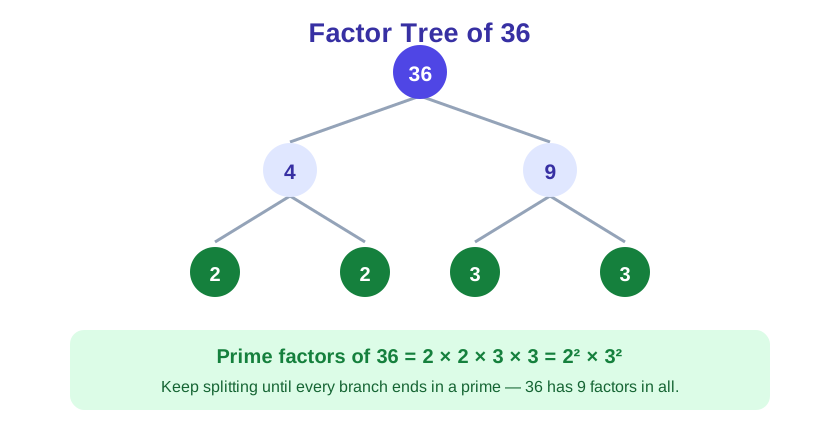
Write the number in prime factorization form, add 1 to each exponent, and multiply the results. Example: 36 = 2² × 3², so (2 + 1) × (2 + 1) = 9, and 36 has exactly 9 factors.
How do you find the square root of 36 by prime factorization?
Break 36 into prime factors: 36 = 2 × 2 × 3 × 3. Pair up the equal primes and take one number from each pair: 2 × 3 = 6. So the square root of 36 is 6.
Back to grades?
Open the Weighted Grade Calculator →